Nobody working on an EV’s high-voltage pack can confirm safety by looking at it. A connector that appears seated, or a cover that appears closed, tells you nothing about whether hundreds of volts are actually live behind it. HVIL — the High Voltage Interlock Loop — exists to take that judgment away from the person and hand it to a circuit. It matters most to whoever designs a retired-battery removal or remanufacturing process, because every step of handling that battery assumes this circuit is doing its job as designed. This piece covers what HVIL is and how it works, why high-voltage systems require it, how it’s physically built into packs and connectors, and what it means once a battery leaves the vehicle for remanufacturing.
A low-voltage signal watching a high-voltage circuit
HVIL is a separate low-voltage signal loop that runs alongside the high-voltage wiring. Every connector joining high-voltage components — the pack, the inverter, the contactor box — carries a small pair of monitoring pins in addition to its main power pins, and those pins only close the loop when the connector is fully mated. The battery management system or vehicle control unit pushes a low current or voltage through this loop and continuously checks that the signal returns intact. If a connector loosens, a pack cover opens, or a service disconnect plug is pulled, the loop breaks — and the controller that detects the break opens the main contactors, cutting the high-voltage circuit itself. HVIL never carries high voltage. It’s a monitoring channel that reports, on the high-voltage circuit’s behalf, whether the physical connection is still intact.
Why high-voltage systems require it
ISO 6469-3 (Electrically propelled road vehicles — Safety specifications — Electrical safety) defines a vehicle battery system as high voltage once its working voltage exceeds 60V DC or 30V AC, and requires systems above that threshold to combine isolation-resistance monitoring, physical shielding, and orange cable coding with automatic shutdown through an interlock circuit. EV traction batteries typically operate in the hundreds of volts, so the moment a connector is pulled or a cover is opened, the risk of shock or arcing is real. HVIL doesn’t leave that judgment to a technician’s attention — it cuts power at the source the instant a connection breaks. The same mechanism protects first responders who reach a vehicle after a crash, not just technicians doing scheduled service.
How it’s built into packs and connectors
The detail worth noting in practice is pin-mating sequence. China’s GB 18384-2020 (Electric vehicles safety requirements) specifies that for a high-voltage connector with interlock function, the power pins must make contact first on mating, with the signal/control (interlock) pins following. That sequence is usually enforced physically by giving pins different lengths — the longer power pins seat first, the shorter interlock pins seat after. Disconnection is the same structure in reverse: because the interlock pins have a shallower insertion depth, they lose contact first, breaking the loop and cutting the circuit before the deeper-seated power pins ever separate. This is a general design principle common across connector manufacturers, not something tied to one standard — and it physically rules out a live power pin coming free on its own. SAE/USCAR-37 — the high-voltage connector performance supplement to SAE/USCAR-2, covering the 60–600V range — sets separate durability and environmental test requirements for these connectors, treating them as a different class from low-voltage ones. At the pack level, the usual design approach ties not just individual connectors but the top cover, the service disconnect, and inter-module busbar joints into a single loop, so there’s no path into the pack that bypasses the circuit.
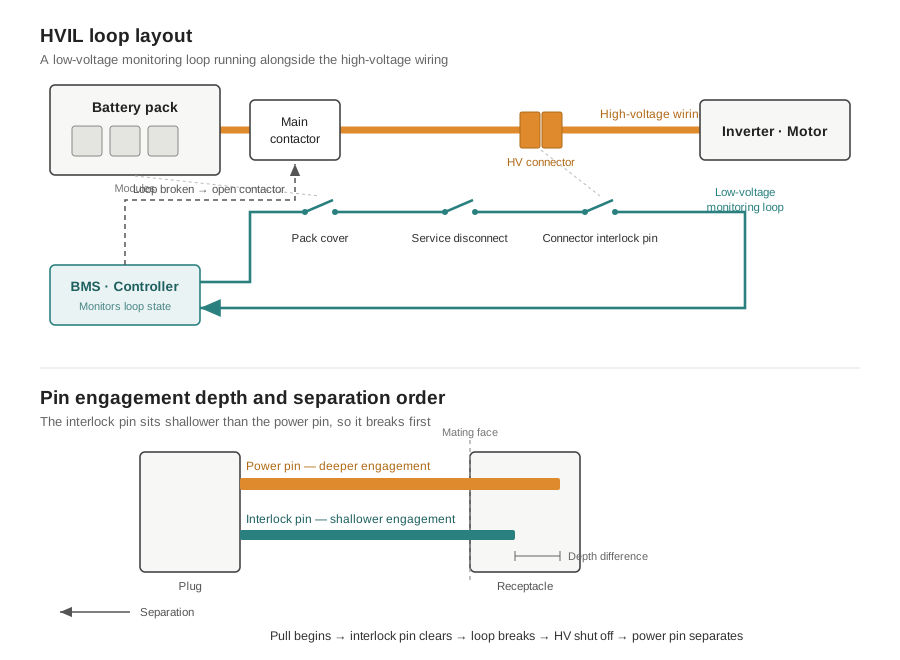 HVIL loop layout and connector pin separation order
What this means for removal and remanufacturing
Every step of pulling a retired battery from a vehicle and rebuilding it assumes the HVIL loop is intact exactly as designed. What a removal technician needs to confirm first is a signal that high voltage is actually cut — not the visual impression that a connector is unplugged. The problem is that remanufacturing and reconfiguration work — opening the pack, swapping modules, re-routing wiring — creates room for that loop to come back together differently from how it was designed. If the loop wiring isn’t restored along its original path, or a monitoring pin itself ends up damaged during reassembly, whoever handles that battery afterward can no longer be certain that pulling a connector will actually cut the circuit. The Certification Path for Remanufactured Batteries covered the pre-distribution safety inspection and the self-administered safety-verification test that remanufacturing operators must run — what those will actually check is still left to lower-level ordinances not yet written, but confirming that the interlock circuit functions as originally designed looks like something that inspection can’t leave out. It’s also the reason handling this circuit at all calls for high-voltage work qualifications and procedure.
ARC’s take
HVIL isn’t really something that shows up as a line item on a certification form — it’s closer to a precondition that has to already be true before a remanufacturing process is even designed. How to verify and document this circuit’s state at the removal stage, and how to re-verify it after reassembly, looks like something Korea’s remanufacturing safety-verification standard will have to address once it’s written into lower-level ordinance — but as of now, that verification procedure itself isn’t standardized.
Related: The Certification Path for Remanufactured Batteries
Source: [ISO] ISO 6469-3:2021, Electrically propelled road vehicles — Safety specifications — Part 3: Electrical safety (https://www.iso.org/standard/81746.html)
Source: [ANSI Webstore] GB 18384-2020, Electric vehicles safety requirements (https://webstore.ansi.org/standards/spc/gb183842020)
Source: [SAE International] USCAR37, High Voltage Connector Performance Supplement to SAE/USCAR-2 (https://www.sae.org/standards/uscar37-high-voltage-connector-performance-supplement-sae-uscar-2/)
Source: [Battery Design] High Voltage Interlock Loop (HVIL) (https://www.batterydesign.net/high-voltage-interlock-loop/)